


The biggest financial surprise most plaintiffs hit is not at the application stage. It is at settlement, when the attorney’s office sends the disbursement statement and the pre-settlement funding payback is two or three times what the plaintiff expected. The contract said 2.9% per month. Nobody explained that 2.9% per month is not 34.8% per year. With monthly compounding, it is closer to 41%, and over 24 months the total payback can nearly double the original advance.
This guide walks through what pre-settlement funding actually costs in 2026, how the math works, what fees beyond the headline rate to watch for, and how the cost compares to your other realistic options. The point is not to scare you off the product. The point is to make sure you sign with full information.
If you want to skip ahead and apply, you can apply now. If you want the numbers first, read on.
TL;DR: Pre-settlement funding in 2026 costs 1.9% to 3.5% per month with monthly compounding, plus optional origination fees of $0 to $750. Total cost depends mostly on how long your case takes to settle, not the headline rate.
Key Takeaways
- Pre-settlement funding monthly rates in 2026 range from 1.9% to 3.5%, based on disclosed contracts in regulated states like New York, Indiana, and Tennessee.
- Rates compound monthly. A 2.9% monthly rate is closer to a 40.9% effective annual rate, not the 34.8% simple math would suggest.
- Origination fees typically run $0 to $750 depending on advance size. Some funders waive them.
- A $10,000 advance at 2.7% monthly compounding costs roughly $1,738 at 6 months, $3,777 at 12 months, and $8,977 at 24 months.
- Duration matters more than rate. A case that resolves in 6 months costs about half of what the same advance costs over 24 months.
- The 76% of civil tort cases that take over 12 months to settle (U.S. DOJ Bureau of Justice Statistics, accessed 2026) is where the compounding math hurts.
For background on the product itself, see how pre-settlement funding works. For an evaluation framework, see best pre-settlement funding companies in 2026.
What Are the Total Costs of Pre-Settlement Funding in 2026?
The total cost of pre-settlement funding is the sum of three components:
- The advance amount you receive
- The compound interest that accrues monthly until settlement
- Origination, processing, or other fees disclosed in the contract
Of these, the compound interest is the largest by a wide margin in most cases, especially when the lawsuit takes more than 12 months to resolve. The headline monthly rate is what gets quoted on the phone. The compounding period is what determines the actual cost.
Industry Rate Ranges in 2026
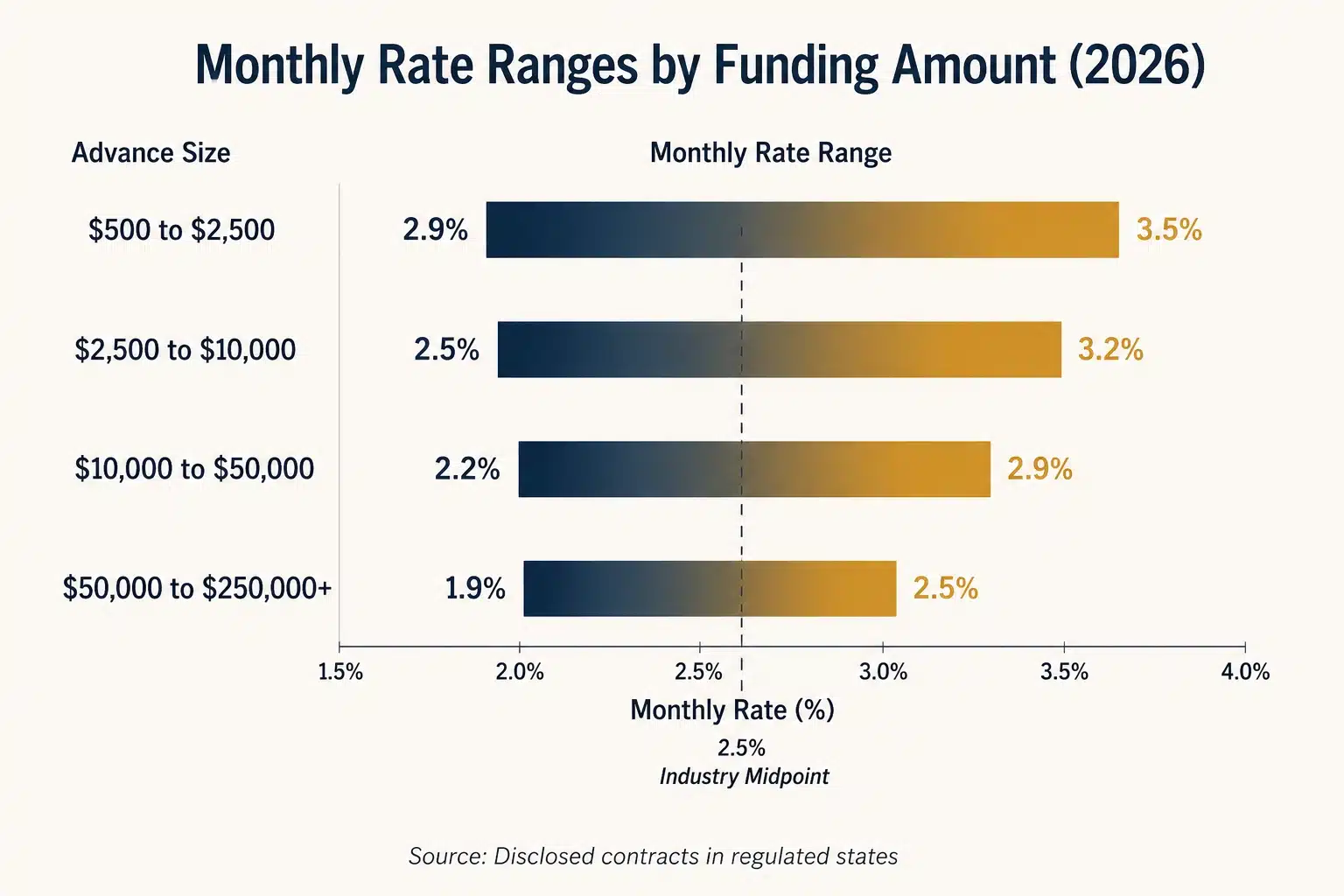
Based on disclosed contracts from funders operating in regulated states (where contract terms are filed with state agencies), the typical monthly rate ranges for reputable funders in 2026 break down by advance size:
| Funding Amount | Monthly Rate | Origination Fee | Effective Annual Rate (approx) |
|---|---|---|---|
| $500 to $2,500 | 2.9% to 3.5% | $0 to $250 | 41% to 51% |
| $2,500 to $10,000 | 2.5% to 3.2% | $0 to $350 | 35% to 46% |
| $10,000 to $50,000 | 2.2% to 2.9% | $0 to $500 | 30% to 41% |
| $50,000 to $250,000+ | 1.9% to 2.5% | $0 to $750 | 25% to 35% |
Source: Compiled from disclosed funding contracts in regulated states and 2026 industry pricing surveys.
Larger advances generally come with lower rates because the underwriting cost is similar regardless of advance size. The funder has to do the same case review work whether the advance is $1,500 or $50,000, so smaller advances cost more per dollar funded. This is also why some funders set minimum advance amounts.
How Does the Monthly Rate Actually Compound?
Monthly compounding is the part of pre-settlement funding pricing that catches most plaintiffs off guard. The math is not complicated. It just produces results that feel surprising.
Simple Interest vs Compound Interest
Simple interest stays the same every month. A $10,000 advance at 2.9% simple interest costs $290 per month, every month, no matter how long the case takes.
Compound interest grows. A $10,000 advance at 2.9% monthly compounding costs $290 in month one. In month two, the 2.9% applies to $10,290 (the original plus month-one interest), producing $298.41. In month three, the 2.9% applies to $10,588.41, producing $307.06. The amount you owe each month gets larger, because the rate is applied to a larger and larger base.
Over 24 months, that compounding gap is significant. Simple interest on $10,000 at 2.9% monthly for 24 months would be $6,960 in fees, for a total payback of $16,960. Compound interest on the same advance over the same period produces a total payback of roughly $19,900, a difference of about $2,940.
Why Compounding Matters More Over Time
The longer your case takes, the more compounding works against you. The pattern is consistent across all advance sizes.
| Months to Settle | Simple Interest Total | Compound Interest Total | Compounding Difference |
|---|---|---|---|
| 6 months | $11,740 | $11,879 | +$139 |
| 12 months | $13,480 | $14,116 | +$636 |
| 18 months | $15,220 | $16,775 | +$1,555 |
| 24 months | $16,960 | $19,929 | +$2,969 |
| 36 months | $20,440 | $28,205 | +$7,765 |
Source: Calculated for a $10,000 advance at 2.9% monthly rate using both simple interest (rate × months) and compound interest (1.029^months) formulas.
The compounding difference at 6 months is small enough that most plaintiffs would not notice it. The compounding difference at 36 months is enough to fundamentally change the value of the funding. This is why duration matters more than the headline rate for most plaintiffs.

What Origination, Processing, and Other Fees Should You Expect?
Beyond the monthly rate, reputable funders may charge several one-time fees. These should all appear in the written contract before you sign. If a funder will not commit to total fees in writing, that is a warning sign covered in our buyer’s guide for evaluating funders.
Origination fee. A one-time charge for processing your funding application and setting up the contract. Typically $0 to $750 in 2026, depending on advance size. Sometimes deducted from the advance (you receive $9,500 on a $10,000 advance with a $500 origination fee), sometimes added to the payback total. The contract should specify which approach the funder uses.
Processing fee. A separate administrative charge that some funders apply on top of the origination fee. Typically $0 to $250 if applied at all. Many funders bundle this into the origination fee or waive it entirely.
Wire fee. A flat charge for wiring funds to your bank account. Typically $25 to $50. This is usually the same regardless of advance amount and is often waived for larger advances.
Case management fee. A monthly recurring fee that a small number of funders charge on top of the monthly rate. Most reputable funders do not charge this. If you see a case management fee in a contract, ask what it is for and whether it can be waived.
Documentation fee. A charge tied to retrieving and reviewing your case file. Most funders absorb this as part of underwriting. If a funder charges a documentation fee, it should be small ($25 to $100) and disclosed upfront.
The total of all fees should appear as a single number on your payback schedule. The schedule should also show fees broken out separately from interest so you can see what each component contributes.
What Determines Your Specific Rate?
Pre-settlement funding rates within the 2026 ranges depend on five factors that the underwriter evaluates.
Case strength. Strong cases get lower rates because the funder’s risk of loss is lower. A clear-liability rear-end collision with documented injuries and an insured defendant gets a better rate than a contested liability case with soft-tissue injuries.
Advance size. Larger advances on stronger cases generally carry lower monthly rates. A $50,000 advance on a $400,000 expected settlement might price at 2.2% monthly. A $1,500 advance on a $15,000 expected settlement might price at 3.3%.
Projected timeline. Funders try to project how long a case will take based on jurisdiction, case stage, and attorney profile. Cases expected to resolve quickly may get slightly better pricing because the compounding works less against the funder’s risk model.
State regulation. Funders operating in states with active oversight (New York, Indiana, Tennessee, Vermont, among others) often have specific rate caps or required disclosures. Rates in regulated states tend to be slightly lower than rates in unregulated states because the regulatory framework filters out the worst actors. See our state directory for state-by-state funding overviews.
Funder portfolio strategy. Different funders target different segments of the market. Some specialize in small advances with higher rates and faster turnaround. Some focus on large catastrophic-injury advances at lower rates and slower underwriting. The rate you are quoted reflects where your case fits in the funder’s portfolio strategy.
The implication is that two different funders will likely quote you different rates for the same case. In cases we have underwritten over the past decade, the spread between competing offers on the same case has commonly been 0.4 to 0.8 percentage points per month, which translates to thousands of dollars difference over an 18-to-24-month case timeline. Comparing offers is standard practice and worth the time. See our pre-settlement funding companies buyer’s guide for the framework.
How Do You Calculate the Total Cost of Your Advance?
The formula for compound interest on pre-settlement funding is straightforward:
Total Payback = Advance Amount × (1 + Monthly Rate)^Months + Fees
For a $10,000 advance at 2.7% monthly compounding over 18 months:
- $10,000 × (1.027)^18 = $10,000 × 1.6170 = $16,170
- Plus any origination or other fees disclosed in the contract
If the funder charges a $500 origination fee deducted from the advance, you receive $9,500 in cash but owe $16,170 plus the $500 (so $16,670 total) at settlement.
If the origination fee is added to the payback total instead of deducted upfront, you receive the full $10,000 in cash but owe $16,670 at settlement.
The contract should specify which approach applies. Either way, the total cost is what matters.
Cost Examples Across Common Scenarios
| Advance | Monthly Rate | 6 Months | 12 Months | 18 Months | 24 Months |
|---|---|---|---|---|---|
| $2,500 | 3.1% | $3,008 | $3,617 | $4,350 | $5,231 |
| $5,000 | 2.9% | $5,940 | $7,056 | $8,385 | $9,963 |
| $10,000 | 2.7% | $11,738 | $13,777 | $16,170 | $18,977 |
| $25,000 | 2.4% | $28,829 | $33,236 | $38,317 | $44,176 |
| $50,000 | 2.2% | $56,985 | $64,929 | $73,981 | $84,294 |
| $100,000 | 2.0% | $112,617 | $126,824 | $142,824 | $160,844 |
Source: Calculated using compound interest formula at 2026 standard industry rates. Excludes origination fees, which add an additional $0 to $750 depending on advance size.
Notice the pattern: the percentage cost (fees as percent of advance) increases significantly over longer timelines. At 6 months, the $10,000 example shows 17.4% in fees. At 24 months, it shows 89.8% in fees.

How Do Pre-Settlement Funding Costs Compare to Other Options?
The honest answer about pre-settlement funding cost is that it is high in absolute terms and reasonable relative to what plaintiffs in active litigation can realistically access. The comparison below uses typical 2026 effective annual cost ranges.
| Funding Option | Typical Cost | Recourse | Credit Required | Realistic Access in Active Litigation |
|---|---|---|---|---|
| Pre-settlement funding | 25% to 50% APR equivalent | None | None | Yes |
| Personal loan (bank) | 7% to 18% APR | Full | Strong credit | Rarely |
| Credit card | 18% to 30% APR | Full | Available credit needed | Sometimes |
| HELOC | 6% to 12% APR | Home as collateral | Strong credit + equity | Rarely |
| 401(k) loan | 6% to 10% APR plus tax exposure | Reduced retirement | None | Sometimes |
| Family or friend loan | 0% to varies | Relational | None | Varies |
The trade-off pre-settlement funding offers is not low cost. It is the combination of accessibility (no credit check, no income requirement) and non-recourse protection (if you lose your case, you owe nothing).
A personal loan at 12% APR is much cheaper in interest cost than pre-settlement funding at 35% effective APR. But the personal loan is full-recourse, requires good credit, and most plaintiffs in serious financial distress during litigation cannot qualify.
For the detailed comparison post, see pre-settlement funding vs personal loans.
What Hidden Fees Should You Watch For?
The cost ranges above describe legitimate pre-settlement funding pricing. The bad actors in the industry use several techniques to make their actual cost higher than what is quoted upfront.
Hidden compounding. Some contracts quote a “rate per month” without explicitly stating that the rate compounds. The default in most contracts is monthly compounding, but a few use simple interest, and a few use weekly compounding which is more expensive than monthly. If the contract does not specify the compounding period, assume monthly and verify in writing.
Use fees instead of interest. Some funders structure their charges as “use fees” that grow on a schedule rather than as interest. The math is identical to compound interest, but the labeling makes the compounding less obvious to plaintiffs who skim the contract. Look for any fee that increases over time and calculate the effective rate.
Tiered rate schedules. A few contracts apply one rate for the first six months, a higher rate for months seven through twelve, and an even higher rate after that. The headline rate quoted on the phone might be the lower introductory rate. Verify the full rate schedule in writing.
Fees added at settlement. Some unscrupulous funders add “settlement processing fees” or “closing fees” at the time of payback that were not clearly disclosed in the original contract. A reputable funder’s total payback is the number on the original payback schedule, period.
Origination fees buried in definitions. Origination fees should appear on the cost summary at the top of the contract. Some predatory contracts hide them in the definitions section or in a separate fee schedule appendix. Read the entire contract, not just the front page.
Mandatory binding arbitration with limited remedies. Not strictly a fee, but a contract clause that limits your options if disputes arise. A reputable funder will not require you to waive your right to dispute charges in court.
The general rule: if you cannot calculate from the contract exactly what you will owe at month 6, month 12, and month 18, the contract is unclear and the unclarity will not work in your favor.

How Have Pre-Settlement Funding Costs Changed in 2026?
Pre-settlement funding pricing has gradually moderated over the past several years, primarily because of three factors.
More state regulation. States that have introduced licensing or disclosure requirements (New York, Indiana, Maine, Nebraska, Oklahoma, Tennessee, Vermont, Wisconsin, per published state legislative records) have created downward pressure on rates. Funders operating in regulated states have to compete on transparent pricing, which constrains how high rates can go.
More funder competition. The number of active funders has grown, which has compressed margins at the larger funding amounts. A $50,000 advance now typically prices at 2.2% monthly. Five years ago that same advance often priced at 2.8% to 3.0% monthly.
More plaintiff awareness. Plaintiffs comparing two or three funders before signing is now standard practice, where it was uncommon a decade ago. Funders who quote noncompetitive rates lose business to funders who do not.
The rates have not collapsed and probably will not. The non-recourse structure means funders absorb the loss on roughly 10% to 15% of funded cases (industry estimate based on disclosed loss-rate data), and the surviving cases have to cover that loss rate to keep the funder solvent. Below a certain price floor, the math does not work.
What has changed is the gap between the best-priced reputable funders and the worst-priced predatory ones. That gap was 4 to 5 percentage points per month in 2020. In 2026, it is closer to 1.5 to 2 percentage points, partly because predatory funders have been pushed out of the most regulated states.
For the regulatory background, the Consumer Financial Protection Bureau publishes general consumer guidance (CFPB consumer education, accessed 2026), though it does not directly regulate the industry at the federal level.
Frequently Asked Questions
What is the typical interest rate on pre-settlement funding?
Monthly rates in 2026 range from 1.9% to 3.5%, compounding monthly. The specific rate depends on advance size, case strength, state regulation, and the funder’s portfolio strategy. Larger advances on stronger cases generally get lower rates.
How is pre-settlement funding interest calculated?
The standard formula is compound interest applied monthly: Total Payback = Advance × (1 + Monthly Rate)^Months. A $10,000 advance at 2.7% monthly compounding over 18 months calculates to $10,000 × 1.027^18 = $16,170.
Do pre-settlement funding companies charge origination fees?
Most reputable funders charge an origination fee of $0 to $750 depending on advance size. Some waive it. The fee may be deducted from the advance or added to the payback total, depending on the contract.
Why are pre-settlement funding rates higher than personal loans?
The non-recourse structure means the funder absorbs the loss if your case fails. Roughly 10% to 15% of funded cases produce no recovery (industry loss-rate data). The surviving cases have to cover the loss rate to keep the funder solvent.
Does the rate decrease if my case settles fast?
Generally no. The monthly rate is fixed in the contract. If your case settles in 3 months instead of 24, you pay 3 months of compounding instead of 24, which dramatically reduces total cost.
Can I negotiate the rate?
Sometimes. Larger advances on strong cases have more negotiation room than small advances on marginal cases. The most effective negotiation tool is having competing offers from other reputable funders.
Will I be charged a fee if I am declined?
No. Reputable funders do not charge fees if your application is declined. Any “funder” that charges a fee for a declined application is not legitimate.
How does the origination fee work?
The origination fee is a one-time charge. It is either deducted from your advance (you receive less cash up front) or added to your payback total (you receive the full advance but owe more at settlement). The contract specifies which approach applies.
What happens to fees if I lose my case?
Nothing. Pre-settlement funding is non-recourse. If your case fails, you owe nothing: not the principal, not the interest, not the fees. This applies even if you have already received the advance.
Are pre-settlement funding fees tax-deductible?
Generally no. Pre-settlement funding is treated as an advance against settlement proceeds, not a loan with deductible interest. Consult a tax professional for guidance specific to your situation.
How do I find a funder with the lowest fees?
Get written offers from two or three reputable funders. Compare the total payback at the expected settlement date, not just the monthly rate. The funder with the lowest monthly rate but a $500 origination fee may cost more than the funder with a slightly higher monthly rate and no origination fee.
Bottom Line
Pre-settlement funding costs in 2026 are real and worth understanding before you sign. Monthly rates of 1.9% to 3.5% with monthly compounding produce effective annual rates of 25% to 50% in most cases. Origination and other fees add another $0 to $750 depending on the funder and advance size.
The compounding math is what catches most plaintiffs off guard. Simple multiplication of the monthly rate undercounts the actual cost, sometimes significantly. The longer your case takes to settle, the more the compounding works against you. A $10,000 advance that resolves in 6 months costs roughly $1,738 in fees. The same advance taking 24 months costs $8,977. The rate did not change. The duration did.
The decision is not whether pre-settlement funding is cheap. It is not. The decision is whether the trade-offs (accessibility, no credit check, non-recourse protection) are worth the cost for your specific situation. For plaintiffs who would otherwise accept a low settlement under financial pressure, the math usually works. For plaintiffs who do not actually need the cash, it does not.
If you have a case and a real financial need, get written offers from two or three reputable funders, compare the total payback at your expected settlement date, and have your attorney review the contract before signing. You can apply with us as one of those conversations. Whatever you decide, decide with the actual numbers, not the headline rate.