


Most plaintiffs hear about pre-settlement funding from someone in their attorney’s office, a friend who has been through litigation, or a Google search at 2am after a third late notice from a hospital. By the time the topic comes up, the financial pressure is already real. Rent is due. The settlement is months away. The insurance adjuster’s last offer would barely cover the medical co-pays.
This guide walks through exactly how pre-settlement funding works in 2026: the mechanics, the math, the qualification rules, the state regulations, the alternatives, and what you should know before you sign. It is long because the topic deserves a real answer.
If you already know the basics and want to apply, you can apply now directly. If you want the foundation first, read on.
TL;DR: Pre-settlement funding is a non-recourse cash advance against your future lawsuit settlement. The 6-step process takes 2 to 5 business days. If you win, you repay from settlement proceeds. If you lose, you owe nothing.
Key Takeaways
- Pre-settlement funding is a non-recourse cash advance against the future proceeds of your lawsuit. If you lose the case, you owe nothing.
- The process moves in six steps: application, attorney coordination, underwriting, contract, disbursement, repayment at settlement.
- Funds typically arrive within 24 to 72 hours of contract signing. There is no credit check and no employment verification.
- Funding amounts in 2026 range from $500 to $250,000+ depending on case strength and projected settlement value.
- Monthly rates range from 1.9% to 3.5% with monthly compounding (industry-disclosed pricing from regulated states). Total cost depends mostly on how long your case takes to settle.
- Roughly 76% of civil tort cases take more than 12 months to resolve (U.S. Department of Justice, Bureau of Justice Statistics, accessed 2026). Pre-settlement funding exists for that gap.
For background on whether funding is right for you, see is pre-settlement funding worth it. For cost details, see pre-settlement funding costs and fees explained.
Table of Contents
What Is Pre-Settlement Funding?
Pre-settlement funding is a cash advance made to a plaintiff during an active lawsuit. The advance is repaid out of the eventual settlement or jury award, not out of the plaintiff’s personal income or assets. If the case does not settle in the plaintiff’s favor, the funder absorbs the loss and the plaintiff owes nothing.
That structure is what makes pre-settlement funding fundamentally different from a loan. A loan creates a personal debt obligation that must be repaid regardless of any external outcome. Pre-settlement funding is a contingent purchase of a share of future legal proceeds. The legal term is non-recourse funding. The practical effect is that your house, your wages, and your other assets are not on the line.
A few things pre-settlement funding is not.
It is not a loan. The non-recourse structure removes it from most state lending regulations.
It is not free money. Funders charge fees, and those fees compound monthly. A delayed settlement costs you more than a fast one.
It is not a way around your attorney. The funder coordinates with your attorney throughout. A funder that tries to bypass your attorney is operating illegally.
It is not insurance. You are not paying premiums. You are receiving cash now in exchange for a portion of your future case proceeds.
For the full legal background, see our pre-settlement funding overview page.
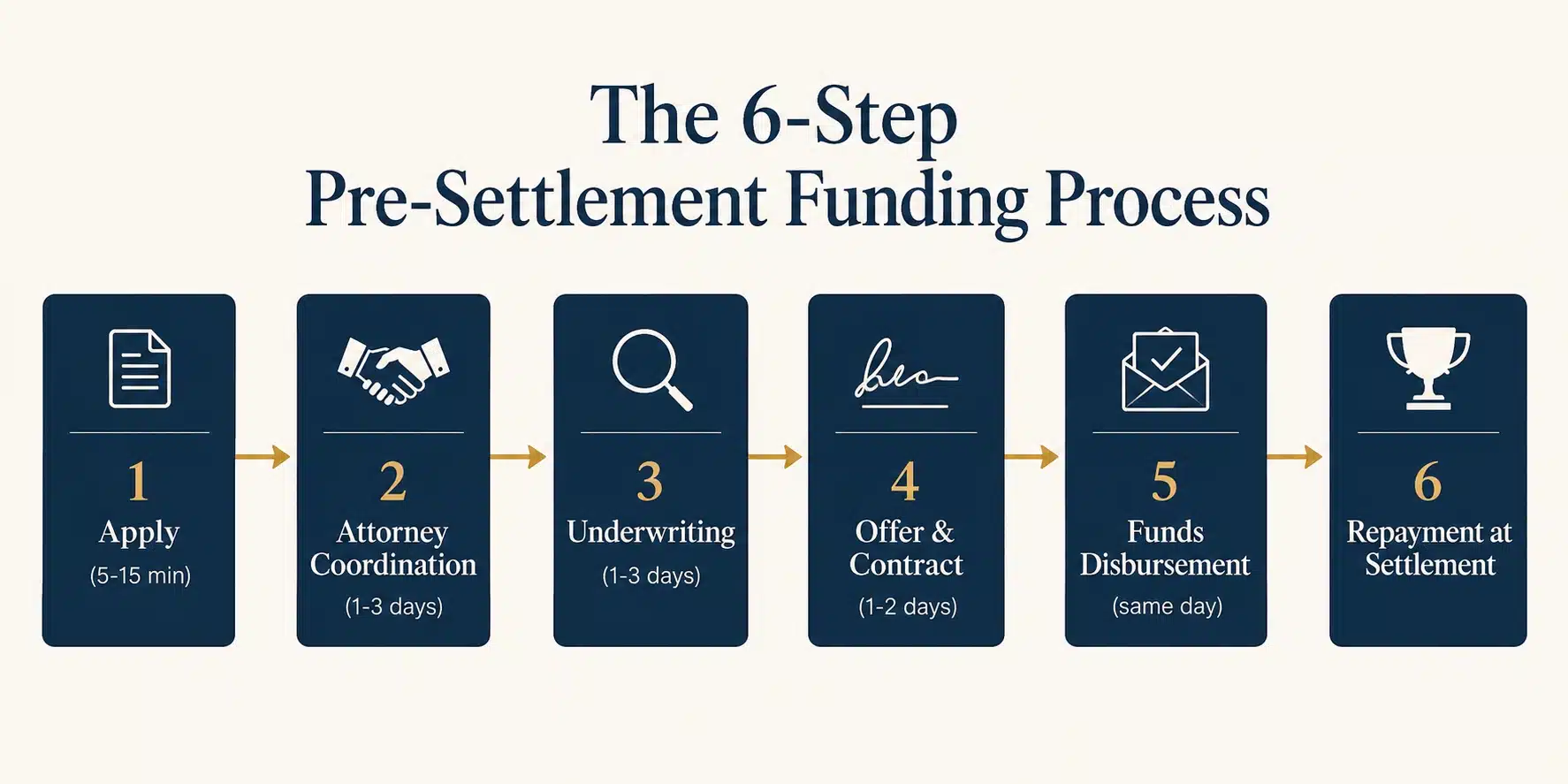
How Does Pre-Settlement Funding Actually Work? The 6-Step Process
Every reputable funder follows the same general workflow. The names may differ, the speed varies, and the underwriting standards are not identical, but the structure below is industry standard in 2026.
Step 1: Application (5 to 15 Minutes)
You apply online or by phone. The application asks for your basic information, your attorney’s contact information, a brief description of your case, and an idea of how much funding you need. There is no credit check, no employment verification, and no income documentation required. The application itself takes most plaintiffs between 5 and 15 minutes.
Most reputable funders will not charge an application fee. If a “funder” asks for an upfront fee to process your application, that is a scam.
Step 2: Attorney Coordination (1 to 3 Business Days)
The funder contacts your attorney’s office. They request the case file, which typically includes the complaint, medical records, police reports (for accident cases), demand letters, and any settlement offers that have been made or rejected. Your attorney’s office sends these documents directly to the funder.
This step depends entirely on how responsive your attorney’s office is. Some firms turn around document requests in hours. Others take a week.
A reputable funder treats your attorney as a professional partner. They make the document request specific, they follow up appropriately, and they do not pressure you to push your attorney for faster turnaround in ways that strain your working relationship. See our attorney funding overview for more on this coordination dynamic.
Step 3: Underwriting (1 to 3 Business Days)
The funder’s underwriting team reviews the case and decides whether to make an offer. They look at several factors.
Liability strength. Is fault clear? Is the defendant identifiable and reachable? Are there comparative negligence issues that could reduce the recovery?
Damages clarity. Can the damages be documented? Medical bills, lost wages, property damage, and pain-and-suffering exposure all matter. Vague damages are hard to underwrite.
Defendant solvency. Is the defendant insured? If so, what are the policy limits? An uninsured defendant with no assets is a problem regardless of how strong the liability case is.
Case stage. Is the case in pre-litigation, in discovery, in mediation, or in trial preparation? Earlier stages mean longer timelines and higher uncertainty.
Attorney quality. Experienced plaintiff’s attorneys with track records on similar cases get easier underwriting.
The underwriter then projects a likely settlement range and uses that to determine how much they will advance. A typical advance is 10% to 20% of the projected settlement value (per industry-disclosed pricing data), though this varies by funder and case type.
Step 4: Offer and Contract Review (1 to 2 Business Days)
If approved, the funder sends a written offer. The offer includes the advance amount, the monthly rate, the compounding schedule, any origination fees or processing fees, a multi-period payback schedule showing what you owe at month 6, month 12, month 18, and beyond, and the non-recourse language.
Read every line. Take the contract to your attorney for review. A reputable funder will not pressure you to sign immediately and will not refuse to let you have your attorney review the contract before signing. If a funder pushes back on attorney review, walk away.
This is also the right point to compare offers. Talking to two or three funders before signing is standard practice and respected by reputable companies. See our buyer’s guide for evaluating funders.
Step 5: Funds Disbursement (Same Day to 24 Hours)
Once you sign, funds are wired or sent via overnight check. Wire transfer is faster. Most plaintiffs receive funds the same day or the next business day after signing.
The funder simultaneously notifies your attorney’s office that an advance has been made and that the funder has a lien against future settlement proceeds. Your attorney records this in the case file so it does not get missed when the case settles.
Step 6: Repayment at Settlement (Months or Years Later)
When your case eventually settles, your attorney pays the funder directly from the settlement proceeds before disbursing the remainder to you. The payback amount is whatever your contract calculates as of the settlement date, based on how many months passed and how the compounding worked out.
If your case does not settle in your favor (you lose at trial, or the case is dismissed), you owe nothing. The funder absorbs the entire loss. This is what non-recourse means in practice.

Who Qualifies for Pre-Settlement Funding in 2026?
The qualification rules for pre-settlement funding are unusual because they have almost nothing to do with you personally and almost everything to do with your case.
Personal Qualifications
You need to be over 18 years old, have a pending civil lawsuit (typically personal injury, employment, or commercial), be represented by a licensed attorney willing to cooperate with the funder, and reside in a state where the funder operates.
You do not need a credit score above any minimum. You do not need steady employment, a bank account history, any income at all, or collateral of any kind.
This is one of the major differences between pre-settlement funding and traditional borrowing. A plaintiff who is unemployed because of their injury, who has a 520 credit score, and who has no savings can still qualify for funding if their case is strong.
Case Qualifications
The case is what gets underwritten. Strong cases get funded. Weak cases get declined.
Eligible case types. Most reputable funders write a broad range of case types: personal injury, motor vehicle accidents (including truck, motorcycle, rideshare, pedestrian, bicycle), workers compensation, medical malpractice, wrongful death, premises liability, product liability, and abuse cases. Mass torts (Camp Lejeune, Roundup, hair relaxer, others) are increasingly funded. Some specialized case types like employment discrimination, civil rights, and commercial litigation have fewer funders that handle them. The full catalog is in our funding categories directory.
Liability clarity. A rear-end collision with a sober defendant is much easier to fund than a multi-vehicle accident where fault is contested.
Damages documentation. Medical records, bills, and lost-wage documentation make underwriting straightforward. Cases with soft-tissue injuries and minimal medical documentation are harder to fund.
Defendant resources. An insured defendant or a corporate defendant is easier to underwrite than an individual defendant with no insurance.
Case stage. A case in active litigation with a defined trial date is more predictable than a case still in pre-litigation negotiation.
If your case is in a marginal category, ask the funder directly: “Do you fund cases like mine? If not, why?” A reputable funder will tell you upfront and save you the application time.
How Much Does Pre-Settlement Funding Cost in 2026?
This is where most plaintiffs make their biggest miscalculation. The headline monthly rate is not the total cost. The compounding period is.
The Rate Structure
Pre-settlement funding rates in 2026 typically run between 1.9% and 3.5% per month (based on disclosed contracts from funders operating in regulated states like New York, Indiana, and Tennessee). The rate depends on the funded amount, the case strength, and the funder. Larger advances on stronger cases generally carry lower rates. Smaller advances on marginal cases carry higher rates.
The rate compounds monthly. This is the part most plaintiffs miss. A 2.9% monthly rate is not 34.8% per year (12 × 2.9%). With monthly compounding, it is roughly 40.9% effective annual rate. Over 24 months, the total cost is significantly higher than simple multiplication would suggest.
Total Cost Examples
| Advance | Monthly Rate | 6 Months | 12 Months | 18 Months | 24 Months |
|---|---|---|---|---|---|
| $5,000 | 2.9% | $5,940 | $7,056 | $8,385 | $9,963 |
| $10,000 | 2.7% | $11,738 | $13,777 | $16,170 | $18,977 |
| $25,000 | 2.4% | $28,829 | $33,236 | $38,317 | $44,176 |
| $50,000 | 2.2% | $56,985 | $64,929 | $73,981 | $84,294 |
Source: Calculated using monthly compound interest formula at standard 2026 industry rates.
The pattern is consistent. The longer the case takes, the disproportionately larger the payback becomes. A case that resolves in 6 months costs roughly half of what the same advance costs if the case takes 24 months.
Origination and Other Fees
Reputable funders may also charge an origination fee ($0 to $500 typical, deducted from the advance), a processing fee ($0 to $250 typical), and a wire fee ($25 to $50 if applicable). All fees should be disclosed in writing before you sign. If a funder will not commit to total fees in writing, that is a warning sign.
For the full cost breakdown including how to think about total cost versus monthly rate, see our detailed costs and fees guide.

How Is Pre-Settlement Funding Different From a Loan?
The non-recourse structure is what makes pre-settlement funding legally distinct from lending. This is not a technicality. It matters in three concrete ways.
Regulation. Most state lending laws do not apply to pre-settlement funding because it is not technically a loan. This is why funders can charge rates based on case strength. The trade-off for the funder is that they accept the full loss if the case fails.
Risk allocation. In a loan, the borrower carries all the risk. If you lose your job, get sick, or have any other financial setback, you still owe the loan. In pre-settlement funding, the funder carries the case risk. If the case fails, the funder absorbs the loss. You owe nothing.
Credit impact. Loans appear on your credit report and affect your score. Pre-settlement funding does not. Reputable funders do not pull credit, do not report to credit bureaus, and do not factor into your credit history at all.
If a “settlement funding” company requires a credit check or reports to credit bureaus, you are being offered a loan, not a true non-recourse pre-settlement advance. The naming may be similar but the product is fundamentally different.
Which Case Types Are Eligible for Pre-Settlement Funding?
Different case types have different funding patterns. The general rules below apply in 2026.
The most commonly funded category is personal injury, which includes slip and fall, dog bite, premises liability, and other accident-based claims. Funding ranges from $1,000 to $250,000+ depending on injury severity and clarity of liability.
Car accident cases are funded by nearly every reputable funder. Clear liability cases (rear-end collisions, drunk-driver fault) are the easiest to underwrite. Truck accident, motorcycle accident, rideshare accident, pedestrian accident, and bicycle accident cases follow similar underwriting patterns with higher average funding amounts.
Workers compensation cases are funded but underwriting is different. The settlement timeline is more variable, the maximum recovery is often capped by state law, and the lien structure can be complex. Not all funders write workers comp cases.
Medical malpractice cases tend to be high-value but slow. Funders that write med mal cases typically require more detailed underwriting and may offer smaller advances relative to projected settlement.
Wrongful death cases are funded for the estate or for surviving family members. Underwriting depends on state law about who can recover and what damages are available.
Mass tort cases including Camp Lejeune, Roundup, hair relaxer, talcum powder, 3M earplugs, and others are funded based on MDL status, bellwether outcomes, and individual plaintiff fit within the broader settlement framework. Mass tort funding is growing rapidly in 2026.
Sexual abuse, institutional abuse, and other abuse-related cases require sensitive underwriting. Recovery values can be substantial but timelines are long. Reputable funders with experience in this category handle the cases with appropriate care.
Civil rights cases, employment discrimination, wrongful termination, wrongful imprisonment, and whistleblower or qui tam cases are funded by funders that specialize in these categories. Underwriting is more involved because damages are often less concrete than in physical injury cases.
For the full catalog with case-by-case details, see our funding categories directory.
How Is Pre-Settlement Funding Regulated in Your State?
Pre-settlement funding regulation is a state-by-state patchwork. There is no federal regulatory framework specific to settlement funding, though the Consumer Financial Protection Bureau has issued consumer guidance (CFPB consumer education, accessed 2026).
The general regulatory categories in 2026:
States with explicit licensing or registration requirements include New York, Indiana, Maine, Nebraska, Oklahoma, Tennessee, Vermont, and Wisconsin. Each requires funders to register with the state, post a bond, or meet specific disclosure standards (per published state legislative records). The list expands periodically as more states address the industry.
States with consumer disclosure requirements. A growing number of states require specific disclosures in pre-settlement funding contracts, even without full licensing frameworks. These typically mandate clear rate disclosure, payback schedules, and non-recourse language.
States with court rulings affecting enforceability. Colorado, Arkansas, and Kentucky have had court decisions or attorney general opinions complicating settlement funding enforceability at various points. A reputable funder will be honest about how those rulings affect their operations in those jurisdictions.
States with general consumer protection oversight. Most other states regulate pre-settlement funding under general consumer protection law without industry-specific frameworks.
The practical effect for plaintiffs: a funder licensed in 35 states is not necessarily licensed in your state. Ask the funder directly about your state. Verify through your state Attorney General office or Department of Financial Services.
For state-specific guidance, see our state directory covering all 50 states.

What Red Flags Should You Watch For in a Funder?
The pre-settlement funding industry has reputable operators and bad actors in roughly equal measure. The bad actors are usually identifiable within minutes if you know what to look for.
Upfront fees are the clearest tell. Legitimate pre-settlement funding never requires payment before the advance is made. Application fees, processing fees, or good-faith deposits requested before funding are scams.
Cold contact is the next obvious sign. Reputable funders do not cold-call accident victims. If a funder contacts you out of the blue shortly after an accident, ask how they got your information. The answer typically involves a referral chain that violates state privacy laws.
Refusal to put pricing in writing is more subtle but just as serious. A funder who quotes a rate verbally but will not commit to a written multi-period payback schedule is leaving themselves room to charge more later.
Pressure to sign immediately disqualifies a funder by itself. Pre-settlement funding contracts deserve careful reading. Any funder who tells you the offer expires in 24 hours, or that you cannot take the contract to your attorney before signing, is using high-pressure tactics that have no place in a real financial transaction.
Attempts to bypass your attorney are not just unprofessional, they are illegal in most jurisdictions. Your attorney is a required part of the process because repayment runs through their trust account.
Hidden compounding is one of the most damaging traps. Some contracts state the rate per month without clearly indicating that interest compounds. Some bury the compounding mechanic in a definitions section. If you cannot tell from the contract what you will owe at month 18, the contract is intentionally unclear.
A funder operating under several different names in recent years is a company that rebrands when reputation damage accumulates. That is not a stable counterparty for a financial commitment that may stretch two or three years.
Missing state licensing is checkable in 15 minutes and disqualifying when it comes up. If your state requires registration or licensing and the funder does not have it, the contract may be unenforceable.
When Does Pre-Settlement Funding Make Sense (And When Doesn’t It)?
This is the part that gets glossed over in most marketing material. Pre-settlement funding is a useful financial product for some plaintiffs and a mistake for others.
When It Usually Makes Sense
The most common scenario where funding pays for itself is when you would otherwise accept a low settlement out of financial pressure. If you would settle for $30,000 today because you cannot pay rent next month, and the case is realistically worth $80,000 if you can wait six more months, the math on funding usually works. Even with substantial fees, the net recovery is higher than the rushed settlement would have been.
Time-sensitive financial obligations are reasonable uses too. Mortgage payments, rent, medical bills, and other obligations that cannot wait until the case settles are predictable expenses. The fees are predictable. The consequences of missing those obligations are not.
When the alternative is higher-interest debt, funding can be the cheaper option. If you would otherwise put medical bills on a credit card at 24% APR, or take out a loan at triple-digit effective rates, pre-settlement funding is usually cheaper despite its own high cost. The non-recourse protection adds value the alternatives do not have.
When It Usually Doesn’t Make Sense
When the case might settle in 60 days, the compounding fees of pre-settlement funding may exceed the value of having cash slightly earlier. Wait if you can.
When you do not actually need the cash. Taking funding because it is available, not because you need it, costs you money. Borrow the minimum you actually need.
When the case is weak and the funder is offering anyway. If a reputable funder declines to fund your case, that is information. A different funder offering high-fee funding on a case the first funder rejected is not a better deal.
When you have a cheaper alternative available. A 0% APR credit card with a 12-month introductory rate, a family loan, or a home equity line of credit are usually cheaper than pre-settlement funding if they are realistic options for you.
What Are the Alternatives to Pre-Settlement Funding?
Pre-settlement funding is not the only option, and it is often not the cheapest. The realistic alternatives most plaintiffs should consider first.
A personal loan from a bank or credit union usually offers lower rates if you can qualify, but it is full-recourse debt. You owe the loan regardless of how your case turns out. Most plaintiffs in serious financial distress do not qualify for personal loans at favorable rates, which is partly why pre-settlement funding exists.
Credit cards are fast and accessible if you have available credit. Effective rates of 20% to 30% APR are common, which is comparable to pre-settlement funding on shorter timelines but carries the same recourse risk as a personal loan.
A loan from family or friends is almost always the cheapest option if it is available. The trade-off is relational, not financial, and only you can judge whether that trade-off is worth it.
A home equity line of credit (HELOC) offers lower rates than most alternatives but puts your home at risk if you cannot repay. It also requires existing equity and good credit, which excludes many plaintiffs in active litigation.
A 401(k) loan is available if you have an employer-sponsored retirement account. Repayment happens through payroll deduction. It reduces your retirement savings and creates problems if you leave the job before repaying.
Hardship withdrawals from retirement accounts are technically possible but expensive once you factor in tax penalties and lost compounding growth.
Negotiating with creditors is often overlooked. Medical providers, in particular, frequently accept reduced or deferred payment from plaintiffs with active personal injury cases. The conversation is worth having before you borrow anything.
A small number of attorneys will advance limited funds against expected settlements, though most decline because it creates ethical conflicts.
For detailed comparisons, see pre-settlement funding vs personal loans.
Frequently Asked Questions
How fast can I get pre-settlement funding?
Most plaintiffs receive funds within 24 to 72 hours of applying, depending on how quickly their attorney’s office sends documentation. Same-day funding is possible if all documents are in order and the case is straightforward.
Do I need to repay pre-settlement funding if I lose my case?
No. Pre-settlement funding is non-recourse. If your case is dismissed, lost at trial, or otherwise resolved without a recovery, you owe the funder nothing. The funder absorbs the entire loss.
Will pre-settlement funding affect my credit score?
No. Reputable pre-settlement funders do not check credit, do not report to credit bureaus, and do not appear on your credit report.
How much funding can I qualify for?
Typical advances are 10% to 20% of the projected settlement value (per industry-disclosed pricing data). A case projected to settle for $50,000 might qualify for $5,000 to $10,000 in advances. Stronger cases with clearer damages qualify for higher percentages.
Can I get pre-settlement funding without an attorney?
No. Pre-settlement funding requires attorney coordination because the funder is repaid through the attorney’s trust account at settlement. If you do not have an attorney, get one before applying.
Can I get pre-settlement funding more than once on the same case?
Yes, though additional advances after the first carry higher rates because the second funder takes a junior position behind the first lien. Plan your funding amount carefully the first time.
What if my settlement is smaller than expected?
The funder is repaid first from settlement proceeds, but only up to the contracted amount. If your settlement is small enough that there is no money left after repayment, the funder cannot pursue you for additional money. The non-recourse protection applies to settlement amount, not just to total case loss.
Are pre-settlement funding companies regulated?
Yes, in a state-by-state way. About 15 states have specific settlement funding statutes in 2026 (per published state legislative records). Other states regulate through general consumer protection law. The Consumer Financial Protection Bureau provides advisory guidance.
Why are pre-settlement funding rates so high?
The non-recourse structure means the funder absorbs the loss if your case fails. To stay solvent across a portfolio of cases that include losses, funders price the surviving cases to cover the loss rate. Roughly 10% to 15% of funded cases produce no recovery at all (industry estimate based on disclosed loss-rate data).
Can I switch funding companies if I am unhappy with mine?
Switching is technically possible but practically difficult once an advance has been written. The original funder has a lien that must be satisfied before any other funder can take a senior position. Evaluate carefully before signing your first contract.
Does pre-settlement funding affect my settlement negotiations?
Indirectly. With funding in place, you can hold out for a fair settlement rather than accept a low offer from financial pressure. The funder does not negotiate for you, but their presence takes away one of the defendant’s pressure tactics.
What happens to pre-settlement funding if my attorney withdraws?
The funding contract is between you and the funder, not your attorney. If your attorney withdraws, you keep the funds and the contract remains in effect. Your new attorney coordinates with the funder going forward.
Bottom Line
Pre-settlement funding works by advancing you cash now in exchange for a portion of your future settlement, structured so that you owe nothing if the case fails. The mechanics are straightforward: apply, attorney coordinates, funder underwrites, contract signs, funds disburse, repayment happens at settlement.
The cost is real. The compounding monthly rates can produce total fees that significantly exceed the original advance if the case takes years to resolve. The non-recourse protection has real value. So does the ability to hold out for a fair settlement instead of accepting a rushed offer. Whether the trade-off makes sense depends on your specific case, your financial situation, and how long your case is realistically going to take.
If you have a case and a real financial need, the practical move is to talk to one or two funders, get written offers, compare them carefully, and have your attorney review the contract before signing. You can apply with us as one of those conversations. The decision is yours, and it should be made with full information about how the product actually works.