

Pre-settlement funding companies are not interchangeable. Some have been around for two decades. Others incorporated last quarter under a name they will change again next year. Telling them apart matters because the contract you sign now is the one that gets repaid out of your settlement two years from now.
The honest version of “best company” is not a ranked list. It is a set of criteria you can apply to any funder you talk to. The funder that is best for a $5,000 advance on a slip-and-fall case in Ohio may not be the funder that is best for a $250,000 advance on a catastrophic injury case in California.
This guide walks through what separates reputable funders from the rest. Use the eight criteria below on any company you consider, including us.
TL;DR: The best pre-settlement funding company in 2026 is the one that meets eight evaluation criteria for your specific case, state, and funding amount. There is no universal winner.
Key Takeaways
- Reputable funders share eight observable traits: transparent pricing, written non-recourse terms, state licensing, attorney cooperation, defined case-type expertise, realistic funding ranges, fast clear answers, and verifiable third-party reviews.
- Pre-settlement funding rates in 2026 typically range from 1.9% to 3.5% per month, compounding monthly, based on disclosed industry pricing in regulated states like New York, Indiana, and Tennessee.
- About 15 states have specific pre-settlement funding statutes requiring licensing or registration, per published state regulator guidance (CFPB consumer education, accessed 2026).
- Funder turnover is high. A company you sign with today may not exist when your case settles. Time in business and reputation longevity matter as much as the rate quote.
Table of Contents
What Does “Best” Actually Mean for a Pre-Settlement Funder in 2026?
The pre-settlement funding industry has changed in three ways since 2020.
First, regulation tightened. More states now require explicit licensing or registration. New York, Maine, Tennessee, Vermont, Indiana, Oklahoma, Nebraska, and Wisconsin have all moved toward formal oversight, based on published state legislative records and Attorney General guidance. The list keeps growing. A funder operating without a license in a state that requires one is not a “best company” in any meaningful sense.
Second, pricing got more transparent in regulated states and less transparent everywhere else. Reputable funders publish rate caps. Predatory ones still bury compounding inside contract language that requires a lawyer to decode.
Third, funding speed converged. In 2020, two-day funding was a competitive advantage. In 2026, same-day or next-day approval is the baseline for any case the funder is willing to take. Speed alone no longer separates good companies from bad ones.
So “best” in 2026 is less about who is fastest. It is about who tells you the truth about the cost, who is licensed in your state, who will fund the kind of case you have, and who will still be around when your case finally settles.

What Eight Criteria Should You Use to Evaluate Any Pre-Settlement Funder?
These eight items should be verifiable within 15 minutes of looking at a funder’s website and asking three questions on the phone. If a company cannot meet all eight, keep looking.
1. Do They Disclose the Full Cost Upfront, Not Just the Monthly Rate?
A 2.9% monthly rate sounds reasonable until you understand it compounds. On a $10,000 advance over 24 months at 2.9% monthly compounding, the total payback is roughly $19,900 (calculated as $10,000 × 1.029^24). Many plaintiffs are quoted the simple rate and end up surprised by the compound math.
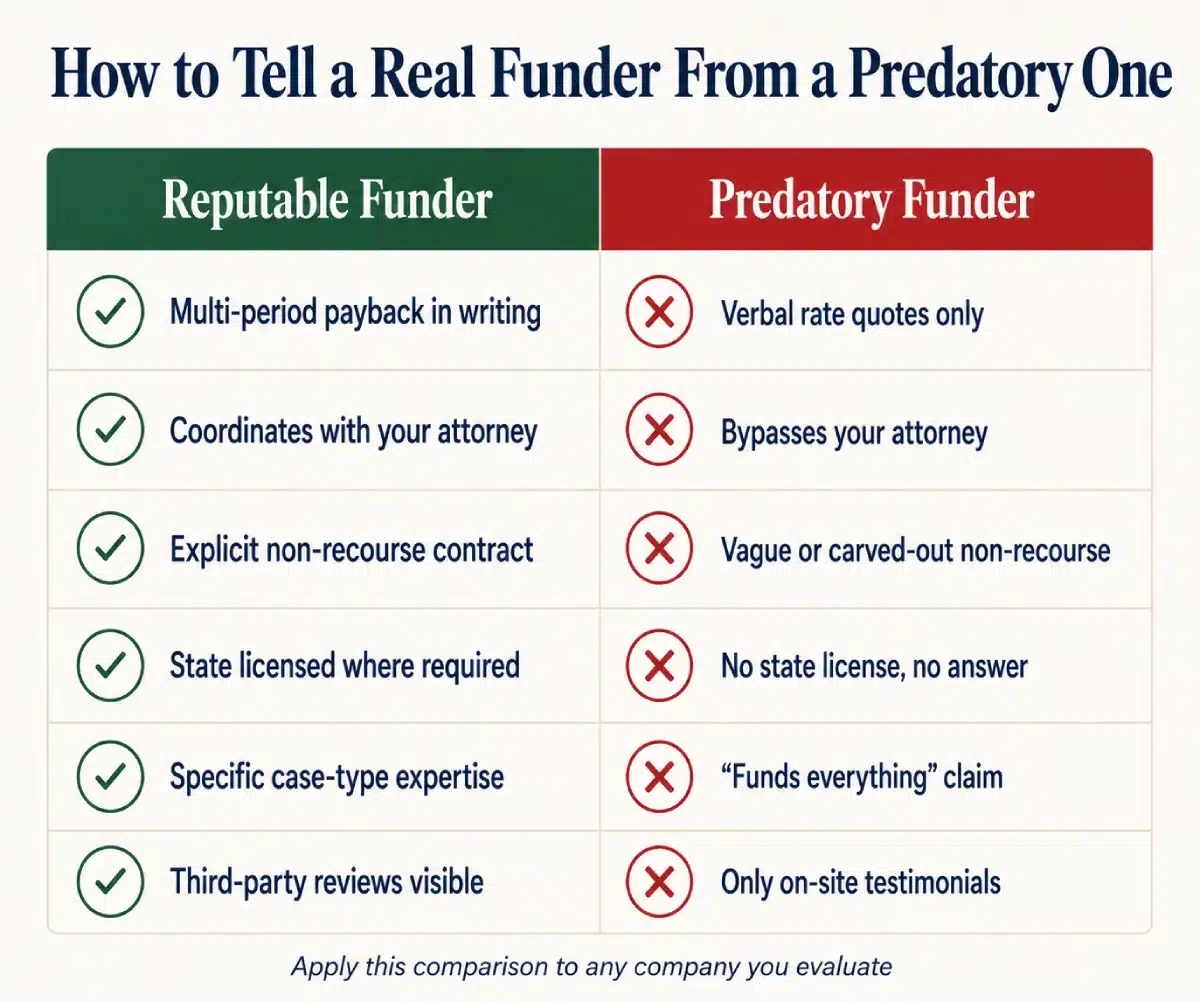
Reputable funders show you a payback schedule listing what you owe at month 6, month 12, month 18, and month 24. Not estimates. Actual numbers based on your funded amount and their rate structure. If a funder will not put a multi-period payback schedule in writing before you sign, they are not the right funder.
Origination fees, processing fees, and case-handling fees should also appear in writing before signing. The total cost of a $10,000 advance over 18 months should be a single number, not a range.
2. Do They Actually Work With Your Attorney, Not Around Them?
Pre-settlement funding only works because the funder coordinates with your attorney’s office. They request the case file, verify the claim, and arrange repayment from settlement proceeds through the attorney’s trust account.
Watch for red flags. Funding a case without contacting your attorney is not legitimate. Trying to keep your attorney out of the conversation is dangerous. Badmouthing your attorney is the company telling you what they are.
Funders who have done this work before introduce themselves to your attorney’s office professionally, name the documents they need, and reference similar cases they have funded. That fluency is not something a newcomer can fake. See more on this dynamic at our attorney funding overview.
3. Is Their Non-Recourse Promise in Writing?
Non-recourse is the entire reason pre-settlement funding exists as a separate financial product. It means if you lose your case, you owe nothing. Not the principal. Not the fees. Nothing.
This protection has to be in the contract. Not in marketing materials. Not in a sales rep’s verbal assurance. In the signed agreement, with explicit language stating that repayment is contingent on the case settling in your favor and that the funder has no recourse against your personal assets.
If the non-recourse clause is missing, vague, or includes carve-outs that effectively cancel it, the product is a loan, not a true pre-settlement advance. A common predatory carve-out is “non-recourse except in cases of fraud,” where fraud is defined so broadly it covers normal disagreements.
4. Do They Actually Fund Your Specific Case Type?
Most funders specialize. Some only fund auto accidents. Some focus on workers compensation. Some do mass torts. Some do not touch medical malpractice because timelines are too long. Some avoid employment cases because damages are too uncertain.
A funder claiming to fund every case type with equal enthusiasm is either lying or stretched too thin to do any of them well. When you call, ask specifically: “Do you fund [your case type]? How many have you funded in the last 12 months? What is your typical funding range?”
Specific numbers in the answer signal real work. Generalities mean they are figuring out whether they can sell you something.
5. Are They Licensed Where They Operate?
Pre-settlement funding regulation is a state-by-state patchwork in 2026. Some states require funders to register, post a bond, or hold an explicit license. Others have consumer protection statutes that apply without licensing requirements.
A reputable funder can tell you in one sentence what their licensing status is in your state. They should be able to send a license number on request. If a funder operates in a state requiring licensing without one, the contract may be unenforceable. That sounds good in theory and is a nightmare in practice.
Verify through your state’s Attorney General office or Department of Financial Services. The Consumer Financial Protection Bureau publishes general guidance on settlement funding consumer rights at consumerfinance.gov. See our state directory for state-by-state funding overviews.
6. Can They Fund the Amount You Actually Need?
Funders have different sweet spots. Some are built for $500 to $5,000 advances on small claims. Some specialize in $10,000 to $50,000 mid-range advances. Some will write $100,000 or more on catastrophic injury, wrongful death, or mass tort cases.
A funder built for small advances will not write $200,000 on a spinal cord injury case, no matter how strong. A funder built for catastrophic cases will not bother with a $1,500 fender-bender.
When you call, ask the range. If your need is at the edge, they will either underwrite reluctantly (and underwrite you down to less than you need) or pass entirely. Either way, knowing upfront beats wasting two days on an application.
7. Do They Tell You No Fast, and Explain Why?
A counter-intuitive sign of a good funder is they say no quickly when they should. A funder who keeps you in the pipeline for a week and then declines without explanation is not respecting your time.
A funder who tells you on the first call that they cannot fund your case type, or that they need to see specific documents before giving a real answer, is giving you useful information.
When they decline, they should give a reason: case type, liability strength, damages clarity, timeline, jurisdiction, or attorney coordination issues. A vague “we just cannot help with this one” is a sign of disorganization or that the company is not built for the case you have.
8. Do Their Reviews Look Like Reviews, Not Testimonials?
Every funder’s website has testimonials. They are almost worthless as evaluation data because they are curated and unverifiable.
Third-party review platforms (Google, BBB, Trustpilot) are more useful. Look at the distribution, not just the average. A funder with 200 reviews where 180 are 5-star and 20 are 1-star is more honest than a funder with 50 reviews that are all 5-star.
Read the negative reviews specifically. The complaints that show up repeatedly tell you what to expect when things go wrong. Late payouts, surprise fees at settlement, communication failures: these patterns matter more than the headline rating.
Better Business Bureau accreditation, time in business, and any consumer protection enforcement actions are publicly searchable. A funder with five years of operation and an A-rated BBB profile is meaningfully different from one that incorporated last quarter.

Which Pre-Settlement Funders Should You Avoid in 2026?
The criteria above tell you what good looks like. These patterns should make you walk away regardless of how attractive the offer sounds.
A funder who refuses to put total payback in writing is leaving themselves room to charge more later. Verbal estimates are not contracts.
A funder asking for upfront fees is running a scam. Legitimate pre-settlement funding never requires payment before funding. If a company asks for an application fee, processing fee, or good-faith deposit before sending money, walk away.
A funder who contacts you first is suspect. Reputable funders do not cold-call accident victims. An unsolicited call from a funding company shortly after your accident usually means a referral chain violating state consumer privacy law.
A funder pressuring you to sign immediately is using high-pressure tactics that have no place in a real financial transaction. Pre-settlement funding contracts deserve careful reading. Any funder telling you the offer expires in 24 hours, or that you cannot take the contract to your attorney before signing, is disqualifying themselves.
A funder trying to bypass your attorney is operating illegally or setting up future disputes. Your attorney needs to be in the loop, period.
A funder whose contract hides the compounding is being intentionally unclear. Some contracts state the rate per month without indicating that interest compounds. Some bury compounding in a definitions section. If you cannot tell from the contract what you will owe at month 18, the ambiguity will not work in your favor.
A funder with multiple Better Business Bureau profiles under different names is a company that rebrands when reputation damage accumulates. Not a stable counterparty for a multi-year financial commitment.
A funder not licensed where required is disqualified by itself. This is checkable in 15 minutes through your state Attorney General office.
How Much Should You Expect to Pay in 2026?
Pre-settlement funding pricing varies by funder, case, and state regulation. The 2026 ranges below reflect publicly disclosed pricing from funders operating in regulated states (New York, Indiana, Tennessee, Vermont), where contract terms are filed with state agencies.
| Funding Amount | Typical Monthly Rate | Typical Origination Fee | 12-Month Total Cost Range |
|---|---|---|---|
| $500 to $2,500 | 2.9% to 3.5% | $0 to $250 | 41% to 51% |
| $2,500 to $10,000 | 2.5% to 3.2% | $0 to $350 | 35% to 46% |
| $10,000 to $50,000 | 2.2% to 2.9% | $0 to $500 | 30% to 41% |
| $50,000 to $250,000+ | 1.9% to 2.5% | $0 to $750 | 25% to 35% |
Source: Compiled from disclosed funding contracts in regulated states and industry pricing surveys, 2026.
Larger funding amounts generally come with lower rates because underwriting costs are similar across loan sizes. Smaller advances cost more per dollar because the funder has the same fixed work to do.
Total cost depends almost entirely on how long your case takes to settle. A $10,000 advance resolving in six months costs roughly $1,500 to $1,900 in fees. The same advance taking two years costs $7,000 to $9,000 because the compounding period is four times longer.
The rate matters. The duration matters more. For the detailed math, read pre-settlement funding costs and fees explained.

How Does State Regulation Affect Your Funding Options?
A funder licensed in 35 states is not necessarily licensed in your state. Pre-settlement funding regulation is fragmented. The funder that is best in California may not even operate in Tennessee.
In 2026, eight states have particularly active oversight: New York, Indiana, Maine, Nebraska, Oklahoma, Tennessee, Vermont, and Wisconsin (per published state legislative records and state Attorney General guidance). Funders operating in these states must meet specific disclosure and registration standards. The practical effect: funders willing to do the registration paperwork are usually running a real business, not a fly-by-night operation.
A few states (notably Colorado, Arkansas, and Kentucky at various points) have had court rulings or attorney general opinions complicating settlement funding enforceability. A reputable funder will be honest about how those rulings affect their willingness to fund cases in those jurisdictions.
For state-specific guidance, see our full state directory covering all 50 states.
How Do We Hold Up Against These Criteria?
It would be strange to publish this framework and not run ourselves through it. Here is the honest version.
Pricing is in writing on every advance. You see the multi-period payback schedule before you sign, not after. Origination fees are disclosed in the same document. The total cost of an $X advance over Y months is one number.
Attorney coordination happens on every case. We will not write an advance without your attorney’s involvement, because the contract relies on their trust account for repayment. Your attorney sees the contract, verifies the funding amount, and signs an acknowledgment before funds are released.
Non-recourse is explicit in the contract language. If your case does not settle in your favor, you owe nothing. No principal, no interest, no fees. We do not include fraud carve-outs that effectively cancel the protection.
The case types we fund span most of what reputable funders write, including personal injury, motor vehicle accidents, workers compensation, medical malpractice, wrongful death, abuse cases, and mass torts. The full list is in our funding categories directory. We tell you upfront if your case type is something we do not write.
State licensing is current wherever required. Our state availability page lists current coverage. If your state has a registration requirement we cannot meet, we say so on the first call.
Our funding range runs from $500 to $250,000 and up, depending on case strength and projected settlement value. Both small and large advances are real conversations here.
Decisions are fast. Most applications get an initial response within 24 hours once we have case documents from your attorney. When the answer is no, you get the reason, not a vague brush-off.
Reviews are on our reviews page and on third-party platforms. We do not curate them.
If those answers match what you are looking for in a funder, you can apply directly. If not, the eight-criterion framework still applies to whoever you talk to next. The framework matters more than the brand on the contract.
Frequently Asked Questions
What is the average cost of pre-settlement funding in 2026?
Monthly rates from reputable funders range from 1.9% to 3.5%, compounding monthly. A $10,000 advance over 18 months typically costs $4,000 to $6,500 in total fees, depending on the rate structure. Larger advances and stronger cases generally get lower rates.
How do I compare pre-settlement funding companies?
Use the eight criteria above: pricing transparency, attorney cooperation, written non-recourse terms, case-type expertise, state licensing, funding range, decision speed with reasons, and third-party reviews. A funder that meets all eight is a serious option regardless of brand recognition.
Is pre-settlement funding the same as a loan?
No. A loan is a recourse debt that must be repaid regardless of outcome. Pre-settlement funding is a non-recourse advance against future lawsuit proceeds. If you lose, you owe nothing. This distinction is what allows pre-settlement funding to operate outside traditional lending regulation in most states.
How fast can pre-settlement funding companies pay out?
Reputable funders provide an initial decision within 24 to 48 hours of receiving case documents from your attorney. Funds typically arrive within 24 hours of contract signing, often the same day. Total time from application to funded is generally 2 to 5 business days.
Do reputable funding companies pull credit?
No. Pre-settlement funding decisions are based on the strength of your lawsuit, not your personal credit. Reputable funders do not run credit checks. Your funding will not appear on your credit report.
What if my attorney does not recommend a funding company?
Most attorneys decline to recommend specific funders because it can create conflicts of interest. Your attorney’s role is to coordinate with the funder you choose, not to choose for you. Apply the eight criteria yourself and present the contract to your attorney for review before signing.
Can I switch funding companies if I am not happy?
Switching is possible but complicated once an advance has been written. The original funder has a lien against your settlement. A new funder would take a junior position, usually at a higher rate. The cleanest time to evaluate is before signing your first contract.
Are pre-settlement funding companies regulated?
Regulation is state by state. About 15 states have specific settlement funding statutes in 2026 requiring licensing or registration. Other states rely on general consumer protection law. The Consumer Financial Protection Bureau publishes advisory guidance but does not directly regulate the industry federally.
What case types do most funders cover?
The most commonly funded case types are auto accident, slip and fall, workers compensation, medical malpractice, and wrongful death. Mass tort funding (Camp Lejeune, Roundup, hair relaxer) is growing rapidly. Employment, commercial litigation, and patent cases are more specialized.
How do I know if a funding company is licensed in my state?
Ask the funder for their license or registration number. Verify through your state Department of Financial Services or Attorney General office. Both maintain public records of licensed financial entities, usually searchable online.
Bottom Line
The best pre-settlement funding company in 2026 is the one that meets the eight criteria for your case, in your state, at the funding amount you need. There is no universal answer.
Avoid the trap of picking based on marketing volume, the company that contacted you first, or the company quoting the lowest headline rate without showing the compounding math. The funders that survive long term, that are licensed where they should be, and that are honest about pricing are a small fraction of the total market.
If you have a case and need an advance, talk to two or three funders, apply the framework to each, and pick the one that fits your situation. You can apply with us as one of those options.
Most plaintiffs spend less than an hour comparing funders before signing. The contract follows them for the next 18 to 36 months. The math on that mismatch is worth thinking about before you sign anything.